Why light guns were the hard problem
Every other arcade control came home easily. Joysticks, buttons, spinners and trackballs are just switches and encoders; they never cared what screen they faced. The classic light gun cared deeply: it timed its shot against the electron beam of a CRT, and when the CRT disappeared, the gun had nothing to read. For years, playing Time Crisis or Virtua Cop at home on a modern display meant sensor bars, compromises, or keeping a tube television alive out of spite.
That era is over. Camera-based guns read the screen itself, and the modern home light-gun scene has settled into three clear routes: one reference product, one clever budget workaround, and one purpose-built cabinet path. This guide takes them in order.
Route one: the camera gun — the reference standard
The Sinden Lightgun with Recoil ($169.99, sold direct from Sinden) is the product that defines the modern category. A camera in the gun reads a thin border around the screen image and triangulates its aim — so it works on LCD, OLED and projectors as happily as on a CRT, with no sensor bars, no external hardware, and no recalibration when you move it between displays. It connects over USB (a generous 5-meter cable), offers ten inputs including trigger and pump action, offscreen reload, and support for Windows, Linux, Raspberry Pi and MiSTer FPGA.
Two honest notes. First, it is sold direct only — there is no Amazon listing, and any marketplace listing claiming otherwise deserves suspicion. Second, the recoil version costs more than the standard gun because the solenoid that kicks in your hand is hardware, not a setting. For a cabinet that will host regular gun-game sessions, it is the version to buy. Ultimarc’s AimTrak is the other respected direct-only name in this space, on the same sold-from-the-maker model; between them, they are the whole serious market.
Route two: the DolphinBar workaround — gun games on a budget
The MAYFLASH DolphinBar takes the opposite approach: instead of a smarter gun, it makes the PC understand a Wii Remote. The bar is a USB sensor bar and Bluetooth adapter in one — pair up to four Wii Remotes with no extra dongle — and its game light-gun mode lets a Remote in an inexpensive gun shell act as the pointer for PC shooting games and the Dolphin emulator, where it is a long-standing favorite.
Set expectations correctly and it is a delight: the tracking is infrared pointing, not camera triangulation, so it asks you to stand at a sensible distance and keep the bar in view. For casual sessions and Wii-native shooters it is entirely convincing, and it is the only genuinely Amazon-stocked light-gun path in our catalog — which is exactly why we carry it.
Route three: let the cabinet be the gun game
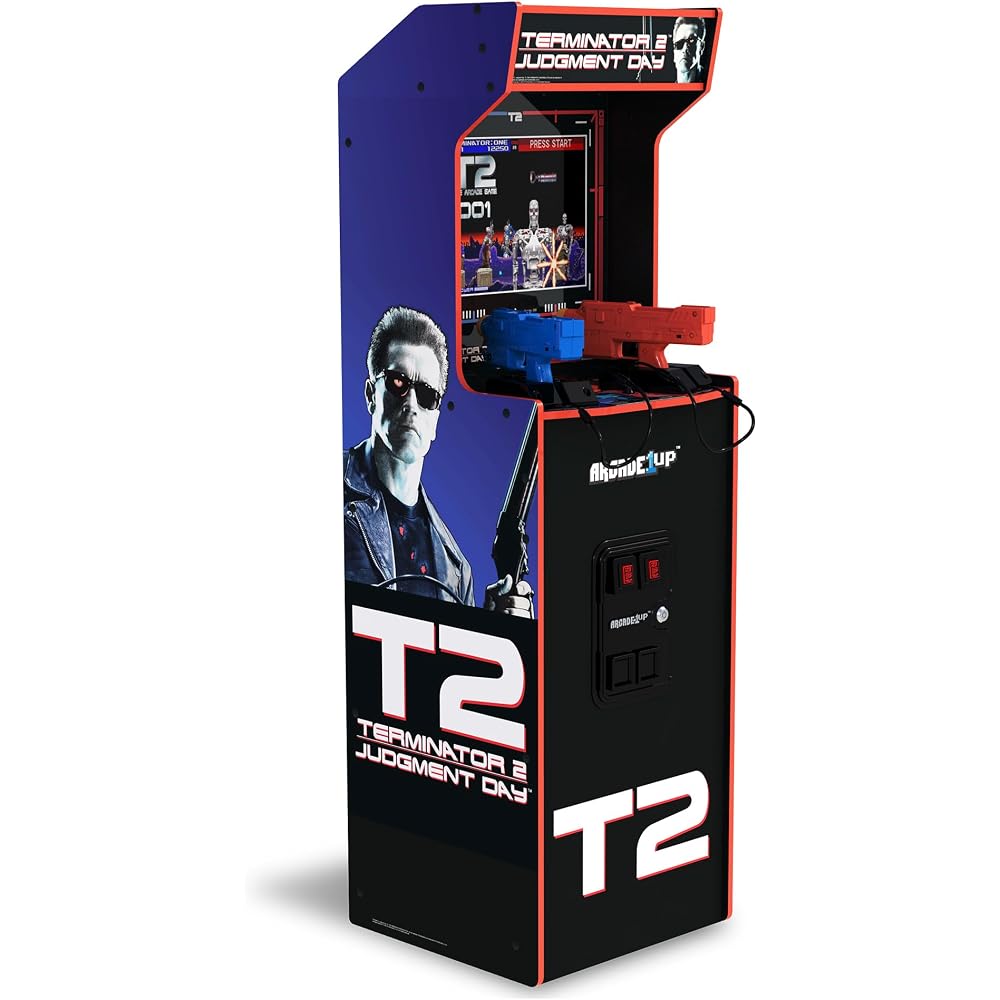
Two cabinets in the catalog exist because gun games deserve dedicated hardware. The Arcade1Up Terminator 2 Deluxe is a single-game, full-height cabinet with two real-feel light guns and 2-player shooting — buy it because you love T2, and it will never disappoint you. Builders go further with the GameRoomSolutions Gun House ($749.99 direct), a full-size flat-pack upright designed around shooter builds, fitting up to a 32-inch screen with panel layouts chosen for gun play. Pair it with a Sinden and a PC or Pi brain and you have the dedicated gun cabinet the arcade charged you a dollar a credit to use.
The three routes, side by side
| Sinden Lightgun | DolphinBar + Wii Remote | Dedicated cabinet | |
|---|---|---|---|
| How it aims | Camera reads the screen border | Infrared sensor bar pointing | Guns fitted to the cabinet (T2) or your choice (Gun House) |
| Displays | LCD, OLED, projector, CRT | Any display the PC drives | The cabinet’s own screen |
| Extra hardware at the screen | None | The bar itself, centered on the display | None |
| Sold | Direct from Sinden — $169.99 for the recoil model | Amazon (see product page) | T2 via Amazon; Gun House direct from GameRoomSolutions — $749.99 |
| Best for | Serious gun library on any screen | Budget and Wii-native sessions | A room anchored by gun games |
Software: the half of the setup nobody warns you about
Hardware is the purchasable half of a light-gun setup; emulator configuration is the other half, and it is where first attempts stall. The principles are consistent across front ends. Your gun must be seen by the emulator as an absolute pointing device — it reports a position on the screen, not a movement — so any setting that treats it as a relative mouse will produce a crosshair that drifts and wanders. Each gun needs its own device assignment, and those assignments should be locked or noted, because USB device order can shuffle between boots and swap player 1’s gun with player 2’s. Calibrate inside each emulator you actually use, not just in the gun’s own utility: the utility proves the gun works, the emulator calibration makes the crosshair agree with the barrel. Finally, test with the room in its playing state — lights as they will be, screen brightness as it will be. Camera-based guns are robust, but they read the screen, and a screen washed out by a window at 4 p.m. is a different target than the same screen at night.
Before you buy: four checks
- Your front end must support the gun. Camera guns present as a mouse-like absolute pointing device; confirm your emulator and front end handle absolute (not relative) pointing, or calibration will fight you.
- Distance is a specification. Every gun system has a minimum and comfortable working distance from the screen. Measure your room and your screen size together — a 32-inch cabinet display and a bar stool two feet away is a different geometry than a projector wall.
- Two players means two guns, and two ports. Budget and wire for the second gun now if head-to-head House of the Dead is the plan; cable management added later is cable management resented forever.
- Recoil needs power. Recoil models draw more from USB than standard guns. A powered hub inside the cabinet is cheap insurance against the classic “works on the bench, flaky in the cab” fault.
Details that separate a setup from a good setup
Three refinements repay their modest cost. First, recoil is not a gimmick: on the Sinden it returns the physical punctuation the games were designed around, and in timed shooters it measurably changes how a session feels — buy it if gun games are a pillar of the cabinet rather than a garnish. Second, holsters: a gun that lives draped over the control panel will eventually be a gun that fell; a simple holster or hook inside the cabinet’s side keeps the hardware safe and the panel clear. Third, a second gun is a different purchase than the first — it converts a library of solo shooters into the head-to-head and co-op sessions that made these games social, so if two-player gun play is even a possibility, wire the powered hub and the second port during the initial build, when the cabinet is open anyway.
The short version
Serious gun cabinet: Sinden, direct, done. Budget or Wii-flavored sessions: DolphinBar and a Wii Remote. A shrine to one great game: the Terminator 2 Deluxe. And if the gun cabinet is the whole point of the build, start from the Gun House shell and work inward. Full specifications for each route are on the product pages linked above.