The first decision is not games. It is furniture.
Every cabinet purchase goes wrong the same way: a buyer falls for a game list, orders the machine, and only then measures the doorway, the wall and the marriage. The format — bartop, 3/4-scale, cocktail table or full-size upright — decides how much floor you give up, whether the cabinet can move rooms without a crew, and which control layouts are even possible. Get the format right and everything downstream gets easier. Get it wrong and no game library will save it.
This guide walks the four formats in our catalog, with the measurements and trade-offs that actually matter, and the specific cabinets we recommend in each.
The four formats, honestly compared
| Format | Footprint | Players | Screen | Build effort | Best for |
|---|---|---|---|---|---|
| Bartop | Sits on a counter or stand; roughly 22″ wide × 21″ deep | 1–2 | 10″–23″ | Kit build, or none (complete kits exist) | Small rooms, desks, first builds |
| 3/4-scale upright | About 18″ × 18″ of floor, 45″ tall | 1–2 | 15.6″–17″ | Home assembly, under an hour | Standing play on a budget |
| Full-size upright | Roughly 19–30″ wide, 61–66″ tall | 2–4 | 17″–32″ | Home assembly or full DIY build | The authentic arcade feel, party play |
| Cocktail table | 34″ × 26″ of floor, 31″ tall | 2, face-to-face | 22″ under glass | Delivered largely assembled | Sit-down play, game rooms that double as living space |
Bartop: the most arcade per square foot
A bartop gives up nothing in game quality — the same emulators, the same controls, the same screens up to 23 inches — and asks only for a sturdy counter, desk or stand. It is also the natural home of the DIY build, because a flat-pack bartop kit is a weekend project rather than a construction job.
Three bartops in our catalog cover the whole range of intent. The Ourcades DIY Bartop Arcade Cabinet ($150 direct from Ourcades) is a true blank shell: pre-cut panels, speaker holes and T-molding slots, and everything else is your choice. The LEP1 Customs LVL23 kit is the best-documented flat-pack in the hobby, fits up to a 23-inch widescreen, and lets you order the panel drilled for HAPP or Sanwa controls. The GameRoomSolutions Bartop Arcade Kit Deluxe ($269.99 direct) removes the friction entirely: black melamine that needs no painting, cam-lock assembly with a screwdriver, and the plexiglass included.
Prefer not to source parts at all? The Pimoroni Picade includes its 10-inch screen and controls in the box — add a Raspberry Pi and build it in an afternoon. The Micro Center Atari Bartop Full Kit goes further still: monitor, controls, speakers, a Raspberry Pi 3B+ and over 140 licensed Atari games, all in one carton.
One specialist worth knowing: if your game list is vertical — 1942, DoDonPachi, the classic vertical shooters — the GameRoomSolutions 22″ Vewlix Vertical ($169.99 direct) is a portrait-layout bartop built for tate play, instead of a horizontal cabinet with a rotated screen and compromised artwork.
3/4-scale and full-size: buying instead of building
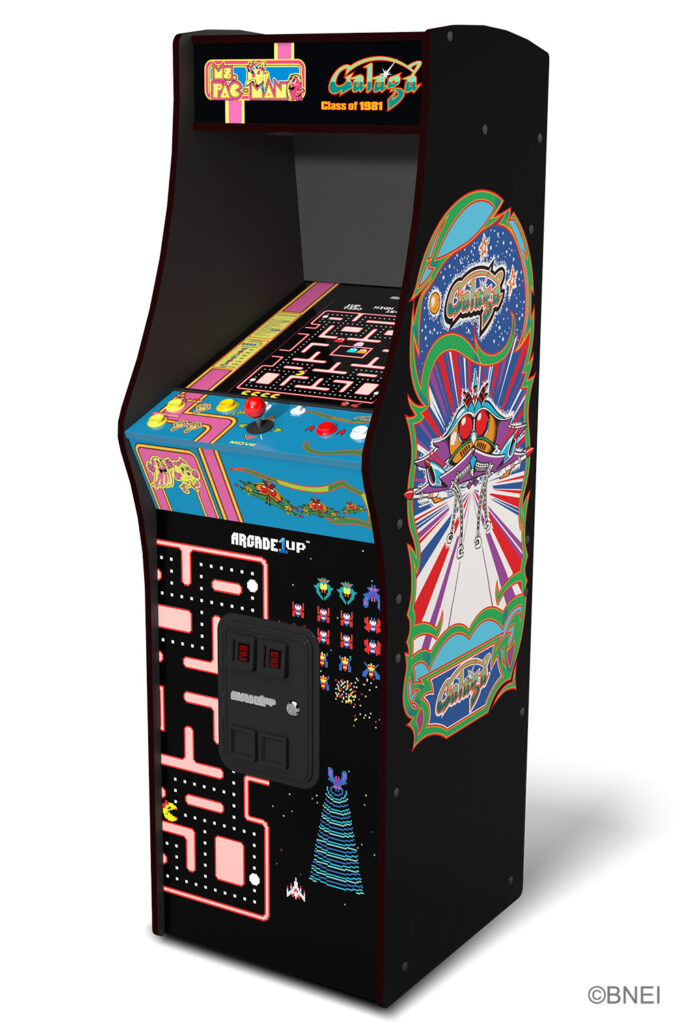
If the project is the purchase rather than the build, the ready-made uprights split by height. The Arcade1Up Ms. Pac-Man Classic SE is a 4-foot, 3/4-scale cabinet with a 15.6-inch screen and 13 games — the least expensive standing format, and the right size for a spare room or a teenager’s bedroom. A riser is available separately if you want full standing height.
The Deluxe line is the full-height answer. The Arcade1Up Class of ’81 Deluxe stands over five feet tall with no riser, a 17-inch screen and the broadest early-’80s game mix Arcade1Up sells. At the other end of the scale, the AtGames Legends Ultimate is a true full-size cabinet — 66 inches tall, a 24-inch screen, 300 games, spinners, a trackball and pinball buttons — for buyers who want one machine instead of a row of them.
Full-size DIY: the upright as a long-term platform
Builders who want full height without a fixed game list should look at upright shells. The Ourcades DIY 2-Player Mega ($350 direct) is a narrower 32-inch-wide upright with options for trackball and spinner prep. The Rec Room Masters Xtension cabinets — the 2-Player and 4-Player (both $880 direct) — are modular: the top half removes to form a pedestal, and control panels swap in minutes, so the cabinet can evolve from a 2-player fighter layout to a 4-player party deck without a rebuild.
Cocktail: the format that shares the room
The cocktail table is the only format that earns its floor space twice — it is a table first and an arcade second. The Top US Video Arcades Cocktail Arcade Machine puts 60 games under tempered glass in a commercial-grade cabinet, with two stools included and a 5-year warranty. Two players sit opposite each other, which suits the head-to-head classics the format was invented for. If your game room is also your living room, this is the format that survives the negotiation.
Measure the journey, not just the destination
One measurement exercise eliminates most format regret: walk the cabinet’s route from the front door to its final wall with a tape measure, and write down the narrowest doorway, the tightest turn and any stair landing. Bartops pass everywhere a person carrying a box passes. Uprights pass most places with the door off its hinges and a friend at the bottom end. The cocktail table, furniture-shaped and 145 pounds in commercial trim, wants a straight, ground-floor run or a professional mover. Formats are sometimes chosen by houses, not buyers — better to discover that at the tape-measure stage than at the threshold.
Also measure the playing envelope honestly. A bartop on a kitchen counter borrows the room’s existing standing space. An upright claims a rectangle of floor plus a stance zone in front of it. A cocktail claims its rectangle plus seating on two sides. The format that “fits” is the one whose full envelope — cabinet, players, spectators — fits.
Upgrade paths and second lives
Formats differ in what happens in year three. A DIY bartop or upright shell is a platform: the brain upgrades from Pi 4 to Pi 5 to mini PC, controls graduate from kit grade to genuine Sanwa, a spinner or trackball joins the panel — the cabinet absorbs all of it because you built it. The Xtension uprights formalize that path with swappable panels and a pedestal conversion. A ready-made cabinet is a finished statement instead: it does not upgrade, it gets joined by a second cabinet, which is how rows happen. A cocktail table, being furniture, simply stays — outliving formats around it and quietly becoming the room’s anchor. None of these futures is wrong, but they are different hobbies wearing the same first purchase, and the format is where you choose among them.
The decision, in four questions
- How much floor can you truly give up? Under two square feet points to a bartop. A dedicated wall points to an upright. A room that must stay a room points to a cocktail.
- Do you want a project or a product? Kits reward builders with exactly the controls and screen they chose. Ready-made cabinets reward everyone else with an evening of assembly and a working machine.
- How many players, honestly? Four-player panels are wide. If Gauntlet and TMNT sessions are the plan, buy the width now — the Xtension 4-Player exists precisely because squeezing four adults onto a 2-player deck disappoints everyone.
- Will it ever move? Bartops travel. Full uprights negotiate stairs badly. Cocktail tables are heavy but furniture-shaped. Decide before the delivery, not during it.
Choose the format first, and the catalog narrows itself. Every cabinet above links to its full product page, with specifications, control layouts and current seller pricing.