Every budget cabinet build starts with the same spreadsheet optimism: the shell is cheap, so the cabinet is cheap. Every budget build ends with the same education: the shell was the down payment. The good news is that a first cabinet can be built genuinely inexpensively — the builders who manage it are not the ones who bought the cheapest of everything, but the ones who knew which three parts carry the experience and refused to economize there, while cheerfully economizing on everything else.
Where the floor actually is
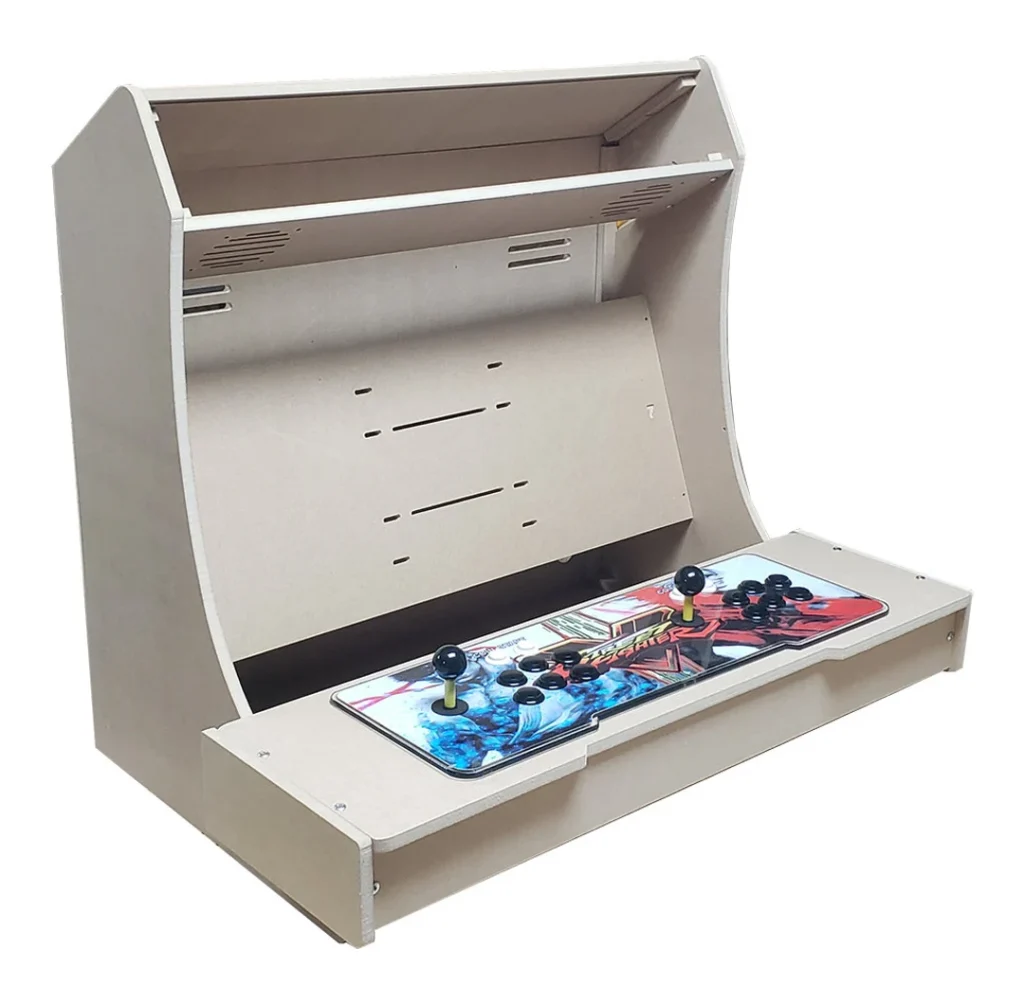
The cheapest verified starting point in our catalog is the Ourcades DIY Bartop at $150 direct: pre-cut panels, speaker holes, T-molding slots and an artwork template — a blank shell, professionally cut, priced like the raw materials it replaces. Step up to the GameRoomSolutions Vewlix Vertical at $169.99 if your heart belongs to vertical shooters, or the GameRoomSolutions Bartop Deluxe at $269.99 if it doesn’t — the Deluxe’s melamine finish and included plexiglass delete the paint, sealant and second hardware-store trip that quietly tax every “cheaper” raw-MDF build.
The three parts that carry the experience
The screen you already own. The single largest budget lever is not buying a monitor. A retired office LCD in the 19–23-inch range — the size these bartops are designed around — costs nothing and performs honestly at bartop distance. Spend the savings elsewhere; upgrade the screen in year two, when you know your most-played games and whether they are 4:3 or widescreen natives.
The controls, complete-kit grade. A complete 2-player kit like the EG STARTS kit (bat tops, American feel) or the Hikig kit (ball tops, Japanese feel) puts sticks, buttons, encoders and wiring in one box with nothing to compatibility-check. Budget controls are legitimately good now; what bankrupts builds is buying parts piecemeal and paying shipping four times. Buy the kit. Genuine Sanwa is a year-two upgrade with a night-and-day difference you will appreciate precisely because you know the baseline.
The brain, kit-grade. The CanaKit Pi 4 Starter PRO is the budget brain done right: board, pre-loaded card, fan case, heat sinks and a proper filtered power supply in one purchase. The false economy here is a bare board plus bargain accessories — the under-rated power supply and absent cooling that cause the classic “crashes after twenty minutes” cabinet, troubleshot for weeks at a saving of very little.
Where to cheerfully cheap out
- Artwork: the vinyl template included with the shells above, printed locally, beats a custom wrap for a first build. Your tastes will change; let them change cheaply.
- Sound: start on the monitor’s speakers or any small powered speaker you own. The amp-and-passive-speakers upgrade is real, well-documented, and entirely deferrable.
- The marquee light: any LED strip works; this is a finishing touch, not a foundation.
- Player 2’s everything: if the cabinet is honestly for one player and occasional guests, a symmetric panel still matters — but the second stick does not need to be the premium one. Yet.
The one-box temptation, priced honestly
The Pimoroni Picade deserves mention in any budget conversation because it inverts the spreadsheet: screen and controls included, a Raspberry Pi to add, and almost nothing else to source. For a desktop-scale first cabinet it can undercut a scratch build once the scratch build’s forgotten line items are counted — and a first build always has forgotten line items. Our full build budget breakdown lists them by name.
The budget rule that survives contact with reality
If a single sentence had to carry this whole post, it would be this: price the build by its second month, not its first day. First-day totals reward every shortcut; second-month totals include the replacement power supply bought in a hurry, the second control kit ordered after the first one’s encoder fought the front end, the screen upgraded immediately because the free one had viewing angles like a privacy filter. None of those are budget failures — they are the ordinary cost of learning, and they shrink dramatically when the first purchase in each category is the complete, documented, kit-grade option rather than the cheapest possible object. Cheap where learning is free (artwork, audio, lighting), complete where learning is expensive (controls, brain, power). That is the whole discipline.
The principle to keep: a budget cabinet is not a cheap cabinet. It is a cabinet whose money is concentrated where hands and eyes spend their time — controls, screen, brain — and withheld everywhere else until the machine has earned its upgrades. Build that one, and the second cabinet (there is usually a second cabinet) starts from knowledge instead of scar tissue.